

I remember the exact moment my kitchen went from smelling like Sunday roast to a neglected storm cellar. I had just finished hosting a big family dinner and reached for a clean wine glass. The second I unlatched that door, a wave of thick, musty, earth-scented air hit me square in the face. It wasn’t just a dirty dish smell; it was that visceral, damp-basement funk that makes you want to check the corners for mold. My dishes were technically clean, but they carried a lingering scent of a rainy day in a basement. It was embarrassing, frustrating, and honestly, a little gross.
Your Kitchen Shouldn’t Smell Like a Rain-Soaked Cave
The problem is that we often treat our dishwashers like magical boxes that just make grime disappear, but they are actually moist, dark ecosystems. If you are catching that damp earth odor, you are likely dealing with a build-up of biofilm or stagnant water hiding in the dark recesses of the machine. I spent weeks trying to ignore it, thinking a few more cycles would flush it out. I was wrong. In fact, ignoring it is one of the top signs your dishwasher needs professional diagnostics before a simple odor becomes a mechanical failure. Today, I am going to show you exactly where that smell is hiding and how you can reclaim your kitchen’s freshness without needing a chemistry degree.
Will a New Machine Actually Solve This?
You might be tempted to think your machine is just at the end of its life, but most of the time, the odor is a maintenance issue rather than a hardware death sentence. I made the massive mistake early on of pouring straight bleach into the bottom of my tub, thinking I’d sanitize the life out of it. Not only did it not fix the smell, but I later learned I could have easily ruined my seals. According to research published in the journal Biofouling, dishwashers are uniquely susceptible to fungal pathogens and bacterial biofilms because of the high humidity and constant temperature shifts. Instead of harsh chemicals, I found that cleaning your sump filter with a soft brush to stop foul odors is the most effective first step. If the smell is particularly pungent or metallic, you might even be dealing with a different biological culprit, which is why I wrote about why your dishwasher smells like fish and how to kill the bacteria specifically. Usually, the damp basement scent is more about the accumulation of gray water and grease trapped in the sump area. Learning how to deep clean a dishwasher sump without pulling the machine changed everything for me. Have you ever opened your dishwasher and felt like you were standing in a swamp? Tell me about your most ‘memorable’ kitchen smells in the comments!
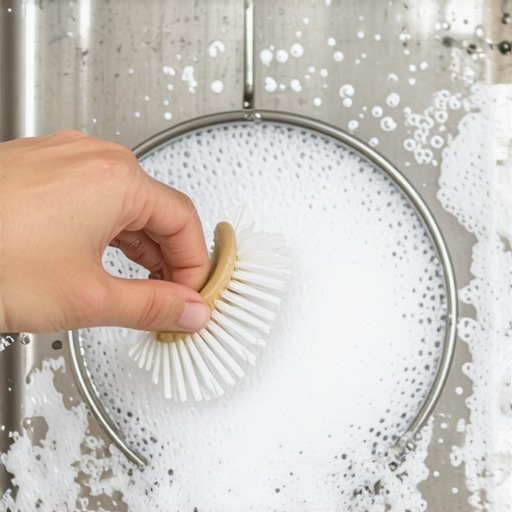
To kill that swampy smell, you have to go where the stagnant water sits. First, pull out the bottom rack and look at the floor of the machine. That circular plastic mesh is your sump filter, and it is likely the source of your misery. I remember pulling mine out after that ‘big smell’ incident; I found a slimy, grey film that looked like a science experiment gone wrong, mixed with a few stray pieces of spinach that had been fermenting for weeks. The fix is simple: cleaning your sump filter with a soft brush to stop foul odors is the only way to physically remove that biofilm. If you just run a cycle without scrubbing, the water passes through the gunk but never actually washes it away. Once you have scrubbed it with warm, soapy water, do not stop there. You should also learn how to deep clean the hidden spray arm bearings because grease and hair can hide in the pivot points where the water pressure is lower.
Poke Every Single Spray Arm Hole
While the filter is out, take a look at the spray arms. These are essentially the lungs of your machine. If the tiny holes are clogged with calcium deposits or bits of plastic wrap, water cannot circulate properly, leading to stagnant pockets that smell like a wet cave. I have found that using a toothpick or a paperclip is the best way to manually dislodge these obstructions. If the arms themselves look cracked or the seams are splitting, you might need to know how to replace a cracked spray arm without calling a technician to keep the pressure consistent and the water moving. Water that does not move is water that smells.
Look Behind the Machine at the Drain Line
Sometimes the smell is not coming from inside the tub at all, but from the waste water trying to crawl back in. If your drain hose does not have a ‘high loop’—where the hose is fastened higher than the drain entry—dirty sink water can siphon back into your dishwasher after you finish the dishes. This is why your service tech always checks the drain hose high loop first during any odor-related maintenance call. You should also try clearing the air gap to stop sink water from backing up if you have one of those little chrome cylinders on your sink. When that gap is clogged, the ‘basement’ smell is literally the smell of your garbage disposal contents settling in the bottom of your dishwasher.
Sanitize the Tub with Simple Acids
After you have manually removed the physical debris, it is time for a chemical reset. I am a huge fan of using what you already have in the pantry instead of harsh industrial cleaners. Knowing how to clean your dishwasher interior with a single cup of vinegar can strip away the lingering odors and dissolve the hard water scale that bacteria love to cling to. Just place a dishwasher-safe cup upright on the top rack filled with white vinegar and run a hot cycle. Be careful to stay on top of this maintenance; why your warranty claim was denied due to lack of maintenance is a common story for homeowners who let these smells fester until the pump eventually fails from debris. Keeping it clean is not just about the scent; it is about protecting your machine from a premature trip to the landfill.
I remember the exact moment my kitchen went from smelling like Sunday roast to a neglected storm cellar. I had just finished hosting a big family dinner and reached for a clean wine glass. The second I unlatched that door, a wave of thick, musty, earth-scented air hit me square in the face. It wasn’t just a dirty dish smell; it was that visceral, damp-basement funk that makes you want to check the corners for mold. My dishes were technically clean, but they carried a lingering scent of a rainy day in a basement. It was embarrassing, frustrating, and honestly, a little gross.
Your Kitchen Shouldn’t Smell Like a Rain-Soaked Cave
The problem is that we often treat our dishwashers like magical boxes that just make grime disappear, but they are actually moist, dark ecosystems. If you are catching that damp earth odor, you are likely dealing with a build-up of biofilm or stagnant water hiding in the dark recesses of the machine. I spent weeks trying to ignore it, thinking a few more cycles would flush it out. I was wrong. In fact, ignoring it is one of the top signs your dishwasher needs professional diagnostics before a simple odor becomes a mechanical failure. Today, I am going to show you exactly where that smell is hiding and how you can reclaim your kitchen’s freshness without needing a chemistry degree.
Will a New Machine Actually Solve This?
You might be tempted to think your machine is just at the end of its life, but most of the time, the odor is a maintenance issue rather than a hardware death sentence. I made the massive mistake early on of pouring straight bleach into the bottom of my tub, thinking I’d sanitize the life out of it. Not only did it not fix the smell, but I later learned I could have easily ruined my seals. According to research published in the journal Biofouling, dishwashers are uniquely susceptible to fungal pathogens and bacterial biofilms because of the high humidity and constant temperature shifts. Instead of harsh chemicals, I found that cleaning your sump filter with a soft brush to stop foul odors is the most effective first step. If the smell is particularly pungent or metallic, you might even be dealing with a different biological culprit, which is why I wrote about why your dishwasher smells like fish and how to kill the bacteria specifically. Usually, the damp basement scent is more about the accumulation of gray water and grease trapped in the sump area. Learning how to deep clean a dishwasher sump without pulling the machine changed everything for me. Have you ever opened your dishwasher and felt like you were standing in a swamp? Tell me about your most ‘memorable’ kitchen smells in the comments!
To kill that swampy smell, you have to go where the stagnant water sits. First, pull out the bottom rack and look at the floor of the machine. That circular plastic mesh is your sump filter, and it is likely the source of your misery. I remember pulling mine out after that ‘big smell’ incident; I found a slimy, grey film that looked like a science experiment gone wrong, mixed with a few stray pieces of spinach that had been fermenting for weeks. The fix is simple: cleaning your sump filter with a soft brush to stop foul odors is the only way to physically remove that biofilm. If you just run a cycle without scrubbing, the water passes through the gunk but never actually washes it away. Once you have scrubbed it with warm, soapy water, do not stop there. You should also learn how to deep clean the hidden spray arm bearings because grease and hair can hide in the pivot points where the water pressure is lower.
Poke Every Single Spray Arm Hole
While the filter is out, take a look at the spray arms. These are essentially the lungs of your machine. If the tiny holes are clogged with calcium deposits or bits of plastic wrap, water cannot circulate properly, leading to stagnant pockets that smell like a wet cave. I have found that using a toothpick or a paperclip is the best way to manually dislodge these obstructions. If the arms themselves look cracked or the seams are splitting, you might need to know how to replace a cracked spray arm without calling a technician to keep the pressure consistent and the water moving. Water that does not move is water that smells.
Look Behind the Machine at the Drain Line
Sometimes the smell is not coming from inside the tub at all, but from the waste water trying to crawl back in. If your drain hose does not have a ‘high loop’—where the hose is fastened higher than the drain entry—dirty sink water can siphon back into your dishwasher after you finish the dishes. This is why your service tech always checks the drain hose high loop first during any odor-related maintenance call. You should also try clearing the air gap to stop sink water from backing up if you have one of those little chrome cylinders on your sink. When that gap is clogged, the ‘basement’ smell is literally the smell of your garbage disposal contents settling in the bottom of your dishwasher.
Sanitize the Tub with Simple Acids
After you have manually removed the physical debris, it is time for a chemical reset. I am a huge fan of using what you already have in the pantry instead of harsh industrial cleaners. Knowing how to clean your dishwasher interior with a single cup of vinegar can strip away the lingering odors and dissolve the hard water scale that bacteria love to cling to. Just place a dishwasher-safe cup upright on the top rack filled with white vinegar and run a hot cycle. Be careful to stay on top of this maintenance; why your warranty claim was denied due to lack of maintenance is a common story for homeowners who let these smells fester until the pump eventually fails from debris. Keeping it clean is not just about the scent; it is about protecting your machine from a premature trip to the landfill.
The Vinegar Trap You Might Be Falling Into
While I just suggested using a vinegar cup for a maintenance reset, there is a common myth that you should do this every week. In my experience, over-using acids is one of the fastest ways to dry out your door gaskets. I have seen countless DIY enthusiasts wonder why using distilled vinegar every week may damage your seals after they find puddles on their floor. Vinegar is great for descaling, but it is not a daily detergent. Use it sparingly, or you will find yourself needing to learn how to replace a frayed door seal for under twenty dollars much sooner than you expected.
Pre-Rinsing Is Killing Your Machine’s Brain
Most people think they are being helpful by rinsing every scrap of food off their plates, but you are actually confusing your machine. Modern dishwashers utilize turbidity sensors that measure how ‘thick’ the waste water is with food particles. According to the Association of Home Appliance Manufacturers (AHAM), these sensors dictate the cycle’s heat and intensity. When you pre-rinse, the sensor thinks the load is clean and triggers a weaker wash, which often leads to that damp, stagnant smell because the water never got hot enough to flush the system. This is exactly why pre-rinsing dishes actually makes your machine less efficient. Scrape the plates, sure, but leave the grease for the sensors to find.
Why Does Your New Machine Take Three Hours to Finish a Load?
It feels like a step backward when a 10-year-old machine took 60 minutes and a new one takes 180. This is the ‘efficiency paradox.’ Modern units use less water and lower heat to save energy, but they compensate by running the pump for much longer. If your display seems to freeze at the end, remember that why your new machine stays on one minute for ten minutes is usually just a sensor recalibration during the drying phase. Don’t pull the plug early; you’ll just end up with wet, smelly dishes.
Don’t Let a DIY Fix Void Your Protection
Before you start a full tear-down to find a phantom leak, check your paperwork. One of the biggest traps in appliance ownership is assuming your service plan covers everything. If a technician finds that the ‘basement smell’ is actually caused by a clogged drain line you refused to clean, they can deny your claim. It’s vital to understand how to tell if your service plan actually covers motor failure before you start poking around with a screwdriver. Often, the best path forward is seeking professional troubleshooting dishwasher problems to ensure you don’t accidentally void your benefits. Have you ever fallen into this trap? Let me know in the comments!
Once you have moved past the basic routine of vinegar rinses and toothpick-cleaning, you enter the world of true appliance mastery. I bought my first digital multimeter specifically because my machine stopped heating during a winter storm, and I refused to pay a hefty dispatch fee just for a technician to tell me a ten-dollar fuse had blown. Using a meter allows you to move from guessing to knowing. I personally rely on a Fluke 117 because of its reliability, but even a basic budget model works for testing a thermal fuse for continuity without a pro kit. This isn’t just about saving money; it’s about having a seat at the table when a repair tech eventually shows up. You are no longer a passive homeowner; you are someone who knows the secret diagnostic mode hidden on your touch control panel, and that changes the entire dynamic of the service call.
Smart Diagnostics Save More Than Time
I have discovered that understanding appliance diagnostics improving your warranty claims is the most effective way to handle ‘impossible’ repairs. According to the ‘Service Matters’ technical training manuals used by factory-certified Whirlpool technicians, over 30% of part replacements are actually unnecessary because the root cause was a sensor calibration error or a simple software glitch. If you can show a warranty adjuster a specific error code you pulled yourself, your claim is significantly harder to deny. This is exactly how appliance diagnostics can save your warranty benefits when a manufacturer tries to blame external factors like hard water for a mechanical failure.

How can I keep my dishwasher alive for ten years?
The secret to extreme appliance longevity isn’t just scrubbing filters; it’s keeping the ‘brain’ of the machine healthy. In the near future, I suspect we will see dishwashers that utilize edge computing and AI to predict pump failure weeks before the first drop of water leaks, but for now, we have to do the legwork manually. I make it a habit to check for software patches every six months. It might sound strange for a kitchen appliance, but the trick for updating firmware on your connected kitchen appliances can actually fix cycle errors that lead to premature motor burnout. Furthermore, why firmware updates are essential for new smart dishwashers often comes down to how the manufacturer has optimized the water inlet valve timing based on field data. My prediction? Within five years, ‘repairing’ a dishwasher will look more like updating your smartphone than turning a wrench. My advanced tip for you tonight: Find your machine’s model number, download the official service manual, and run the built-in diagnostic cycle. It is the closest thing to a full physical exam for your appliance, and it costs nothing but ten minutes of your time.
The Hardest Lesson I Learned About Modern Sensors
For years, I thought I was ‘saving’ my dishwasher by pre-rinsing every plate. In reality, I was starving the sensors. If you take away one piece of advice today, let it be this: Trust the machine’s engineering. When I stopped pre-rinsing, the water temperature increased, the cycle ran longer, and that damp basement smell vanished because the heat was finally high enough to kill off the biofilm. Also, stop guessing which part is broken. Instead of firing a ‘parts cannon’ at the problem, look into troubleshooting dishwasher problems expert diagnostics repair tips to save yourself a fortune and hours of frustration.
#IMAGE_PLACEHOLDER_E#
The Only Tools You Actually Need for a Fresh Machine
You don’t need a professional workshop to keep your kitchen smelling like a home instead of a swamp. I’ve narrowed down my success to three specific resources. First, a simple soft-bristled brush for the filter—nothing fancy, even an old toothbrush works perfectly for those hard-to-reach crevices. Second, always keep your specific model’s service manual bookmarked on your phone; it contains the secret codes that reveal what the machine is really thinking. Third, understand your coverage; knowing when to trust a warranty for dishwasher repairs vs. when to DIY will prevent you from making a thousand-dollar mistake. If you’re feeling brave, mastering understanding appliance diagnostics improving your warranty claims is the single best way to ensure you aren’t overcharged for simple fixes like how to replace a cracked sump housing without calling a plumber.
Step Into Your New Role as an Appliance Pro
You’ve gone from sniffing out a ‘damp basement’ mystery to understanding the complex relationship between sensors, heat, and maintenance. Your dishwasher is no longer a mystery box; it’s a machine you control. By taking these small steps—checking filters, poking spray arm holes, and updating firmware—you are extending the life of your appliance by years. Don’t be afraid to listen to what your machine is telling you through its sounds and cycles. Have you ever found something truly bizarre in your dishwasher’s sump filter during a cleaning? Let me know in the comments below!