

I remember standing in my kitchen last Tuesday, staring at a load of ‘clean’ dishes that smelled faintly like a wet dog. It’s frustrating, right? You pay a small fortune for a high-end appliance, only to find a gritty film on your favorite wine glasses. For the longest time, I thought the solution was to scrub harder before loading, but I eventually learned why pre-rinsing dishes actually makes your machine less efficient. My lightbulb moment came when I realized the machine wasn’t cleaning my dishes because it was too busy being filthy itself.
Your Dishwasher Needs a Bath More Than Your Plates Do
If you have ever noticed that lingering funk, you are probably dealing with why your dishwasher still smells like old food after cleaning: grease and limescale buildup in the crevices you can’t see. I used to be the person who ignored the hidden filter most owners never clean, and let me tell you, that was a smelly mistake. The fix isn’t a cabinet full of expensive chemicals; it is a single cup of white vinegar sitting right in your pantry. We are going to walk through how to strip away that hard water scale and restore your machine’s performance without calling a repair tech. Have you ever opened your machine and felt like it was actually making your kitchen dirtier?
Will a cup of vinegar actually ruin my rubber seals?
It is the number one question I get from skeptical friends. The truth is that while vinegar is a powerhouse, using distilled vinegar every week may damage your seals over the long haul. However, when used as a monthly deep-clean tool, it is a game changer. According to testing by Consumer Reports, the acetic acid in white vinegar is perfectly formulated to dissolve the calcium and magnesium deposits that lead to clogged spray arm nozzles. I once let my machine go so long without a descale that the water couldn’t even reach the top rack! By the time we are done here, you will know exactly how to time your vinegar rinse to get that ‘new appliance’ shine back.
Clear the Debris Before You Start the Cycle
Before you even touch that bottle of white vinegar, you have to clear the ‘lungs’ of your machine. Think of the filter like a vacuum bag; once it is full, it just recirculates dirt back onto your ‘clean’ plates. I once spent forty-five minutes wondering why my top rack was covered in grit, only to find a shard of a broken glass and an old pea stuck in the hidden filter most owners never clean. Reach into the bottom of the tub, twist that cylinder out, and give it a good scrub with a soft brush under hot water. If you see a thick, slimy residue, you are looking at fat and protein buildup that vinegar alone won’t kill. In those cases, you might need to learn how to clean out grease build-up in a drain impeller to prevent a total backup. 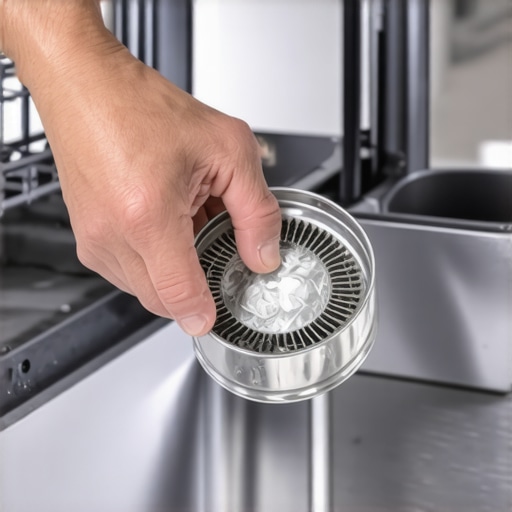
The Filter is Usually the Real Culprit
When the filter is blocked, the wash water cannot drain fast enough, leading to stagnant pools that harbor bacteria. I remember a specific Saturday when I ignored a slight smell; within two days, my entire kitchen smelled like a swamp. By physically removing the gunk first, you ensure the vinegar can actually reach the interior surfaces of the tub instead of just fighting through a layer of old lasagna.
Run the Vinegar Rinse the Right Way
Once the physical barriers are gone, place a dishwasher-safe bowl filled with one cup of white vinegar on the top rack. This is where most people mess up: they pour the vinegar directly into the bottom of the machine. Most modern machines start their cycle with a quick drain-out to remove any standing water. If you pour the vinegar in the bottom, you are literally flushing your cleaning agent down the toilet before the cycle even begins. Setting the bowl on the top rack allows the vinegar to disperse slowly as the water sprays. This slow-release method is crucial because why your warranty claim was denied due to lack of maintenance often comes down to internal scale buildup that a simple, properly executed vinegar rinse would have prevented.
How This Saves Your Warranty Coverage
Appliance manufacturers expect a certain level of homeowner care. If a technician comes out and finds the internal sensors are coated in calcium, they may label it as ‘owner neglect.’ By understanding appliance diagnostics improving your warranty claims, you can prove that you have been performing regular descaling. This small habit makes you look like a responsible owner when you eventually need to call in a pro.
Listen to Your Machine While It Works
While the vinegar cycle is running, pay close attention to the acoustics. A healthy dishwasher should sound like rhythmic waves hitting the door. If you hear a mechanical grind or a high-pitched squeal, you need to know the trick to identifying a failing drain pump by sound before you face a flood. I once had a client whose dishwasher sounded like a woodchipper; we pulled the assembly apart and found a single penny wedged in the impeller. A five-cent problem nearly cost them a $300 pump replacement. If you notice the water isn’t hitting the top rack properly even after the vinegar, you might need to try the toothpick method for unclogging spray nozzles to clear out any stubborn seeds or plastic bits that the acid couldn’t dissolve.
Detergent Pods Might Be Killing Your Pump
Most people assume that buying the most expensive, ‘ultra-power’ detergent pod is the best way to care for their machine. In reality, why your service tech secretly hates pod detergents is one of the industry’s best-kept secrets. These pods are often overloaded with surfactants that create excessive foam in modern high-efficiency (HE) machines. In my experience, this ‘over-sudsing’ creates an air pocket in the circulation pump, leading to a dry-run condition that wears out the bearings prematurely. If you have noticed a groan from your machine, you need to know how to stop a high-pitched squeal from your circulation pump before the motor burns out entirely. A study by the Association of Home Appliance Manufacturers (AHAM) highlights that using too much detergent in low-water systems actually leaves more residue than using less, because the machine can’t rinse it all away. This is exactly why your high-efficiency machine hates cheap pods—they just don’t dissolve at the right rate for the shorter, cooler cycles of modern eco-modes.
Don’t Let a Software Glitch Brick Your Control Board
We rarely think of our dishwashers as computers, but the main control board is essentially the brain of your kitchen. One of the most frustrating ‘traps’ for the modern homeowner is the firmware update. I’ve seen cases where a routine update failed because of a weak router signal, leading to why your appliance firmware update just bricked the control board. If your machine is ‘smart,’ you need to ensure a stable connection before hitting ‘accept.’ Sometimes, why your smart dishwasher keeps dropping its wi-fi connection isn’t just an annoyance; it’s a risk to the machine’s operational health. 
Can a Simple Kitchen Remodel Void Your Entire Warranty?
It sounds like a myth, but it’s a very real danger in the fine print of many service contracts. There is often the clause that voids your coverage if you move the appliance without a certified professional. I once worked with a homeowner who pulled their dishwasher out just to paint the wall behind it, and when the drain pump failed a month later, the claim was denied because the ‘installation’ had been tampered with. This is why why your warranty terms change after the first year; the rules get much stricter. Before you even think about a DIY repair, consider the truth about non-manufacturer repair parts and your warranty. Using a generic $15 part to save money today could cost you a $500 covered repair tomorrow if the manufacturer spots the third-party component. Have you ever fallen into this trap of accidentally voiding a service plan? Let me know in the comments. By understanding appliance diagnostics improving your warranty claims, you can navigate these technicalities and keep your machine running for years.
Tools You Need to Stop Guessing
When I finally got serious about my kitchen maintenance, I stopped relying on ‘vibes’ and bought a basic digital multimeter. It is the difference between guessing why the water isn’t hot and testing your heating element for ground-faults with a meter to find the literal broken wire. You do not need a degree in electrical engineering, just a bit of patience. For those hard-to-see leaks, I swear by the flashlight trick for finding micro-cracks in your spray arm. A simple LED light held at an angle reveals hairline fractures that are invisible to the naked eye but cause a mess every Tuesday night. If you want to be even more efficient, check the five-minute fix for a loose spray arm nut before you assume the whole assembly is toast. #IMAGE_PLACE_HOLDER_D#
How do I keep my dishwasher alive for over a decade?
Consistency is the only ‘secret’ ingredient. I have found that the real cost of skipping your monthly descaling cycle is not just a bit of lime; it is the shortened lifespan of every rubber seal in the pump housing. You should also get comfortable with the secret tech menu that calibrates your water sensors. Most modern machines from brands like Bosch or Whirlpool have a hidden button sequence that forces the machine to re-read its internal environment. According to the Association of Home Appliance Manufacturers (AHAM), nearly 30% of service calls for ‘poor cleaning’ are actually resolved through simple sensor recalibration rather than expensive part replacement. Even if you are not tech-savvy, you can still learn how to test a door latch with a business card to ensure the seal is tight enough to maintain the internal heat needed for a proper sanitize cycle.
The Future of Repair is Hiding in Your Wi-Fi
As we move toward a more connected kitchen, the way we handle understanding appliance diagnostics improving your warranty claims is shifting toward software. I predict that within five years, your dishwasher will predict its own pump failure weeks before it happens. However, this connectivity comes with new headaches. You might find why your smart home hub is blocking appliance commands because of a simple IP conflict. Just like your phone, why your smart appliance needs regular software cache clears is becoming a standard maintenance step. If you are struggling with a buggy interface, the trick for updating firmware on your connected kitchen appliances often involves a dedicated 2.4GHz guest network. I have seen how smart diagnostic apps are changing home appliance repair by giving homeowners the same error codes that used to be a trade secret. Try this today: Look up your specific model number plus ‘service manual’ online and see if you can find the button sequence for the ‘Service Mode.’ Running a self-test tonight could save you a $200 diagnostic fee tomorrow.
Secrets the Repair Tech Told Me After Three Visits
After years of wrestling with scale and smells, I realized that the best tool for appliance longevity isn’t a wrench—it’s consistent knowledge. One of the biggest shifts in my perspective was learning how to calibrate your dishwasher turbidity sensor with plain water. It sounds technical, but it’s essentially teaching your machine how to ‘see’ dirt again, which prevents it from overworking itself. I also discovered that if a warranty claim gets tossed out, you can often find a path forward by knowing how to appeal a rejected extended warranty claim using your own maintenance logs as proof of care. My biggest ‘aha’ moment? Realizing the machine is a connected system. When one part struggles, the rest follow, which is why troubleshooting dishwasher problems expert diagnostics repair tips focus so much on the basics like filters and spray arms before jumping to a motor replacement.
The Minimalist Toolbag for Every Dishwasher Owner
You do not need a garage full of gear to keep your kitchen running. I personally rely on a simple digital multimeter for testing your heating element for ground-faults with a meter whenever my dishes come out cold and damp. I also keep a high-lumen LED handy for the flashlight trick for finding micro-cracks in your spray arm, which has saved me from at least two mystery leaks that would have ruined my floors. Finally, I highly recommend downloading your manufacturer’s official app; seeing how appliance diagnostics can save your warranty benefits firsthand often comes down to having that digital paper trail of your machine’s health history ready for a technician.
You Are More Capable of This Repair Than You Think
Maintaining your appliance doesn’t have to be a chore that you dread every month. When you take the time to understand the ‘why’ behind the vinegar rinse or the filter scrub, you stop being a victim of your appliances and start being the master of your kitchen. The peace of mind that comes from a machine that actually works—and the hundreds of dollars saved in service fees—is worth every minute of effort. Your dishwasher is a workhorse, and with these few simple habits, it will keep your plates sparkling for a decade or more. Have you ever successfully fixed a dishwasher issue yourself, or did a ‘simple’ repair turn into a weekend-long project? Let me know your stories in the comments below!