

It was exactly 11:42 PM when I realized my kitchen had been transformed into a perpetual slurping machine. I stood there, half-awake in my bathrobe, staring at my dishwasher. The cycle had finished over an hour ago, yet the drain pump was still humming with a desperate, rhythmic thumping. I felt that familiar knot of anxiety in my chest—the one that tells you a very expensive repair bill is on the horizon. My first instinct was to pull the machine out and start hacking at the wires, but I’ve learned from years of trial and error that these machines are often just trying to protect themselves. This “phantom drain” is a cry for help, not necessarily a death rattle. Today, I’m going to share exactly why your machine is acting like it’s drowning and how we can quiet the beast without calling in a pro.
Stop the Slurping Sound Before Your Pump Burns Out
When my machine first did this, I made a classic rookie mistake: I assumed the drain pump was broken because it wouldn’t stop running. I actually spent nearly $200 on a replacement part and three hours of my Saturday afternoon installing it, only to find out the pump was fine—it was just receiving a signal that wouldn’t let it quit. Most of the time, your dishwasher thinks there’s a leak in the base pan, and it’s stuck in an emergency anti-flood loop. You might be surprised to learn that troubleshooting dishwasher problems often reveals that the pump is the messenger, not the culprit. If you’ve ever felt like your appliance was gasping for air, you aren’t alone. It’s a stressful sound, especially when you’re worried about the motor burning out. But before you pull the plug, understand that why your service tech always checks the drain hose high loop is often because a simple siphoning issue can trick the sensors into thinking the tub is never empty.
Does a Persistent Pump Mean Your Dishwasher is Garbage?
I know what you’re thinking: if the machine won’t turn off, it must be the control board. That’s the big scary repair everyone fears because those boards cost half as much as a new unit. But is it actually worth the stress? Not usually. According to data from the Association of Home Appliance Manufacturers (AHAM), modern dishwashers are designed with incredibly sensitive safety switches that trigger at the slightest hint of moisture where it shouldn’t be. This isn’t a failure; it’s a safety feature designed to save your hardwood floors. My own lightbulb moment happened when I discovered you can often test your float switch using a plastic straw to see if it’s just stuck on some leftover debris. Have you ever had your machine stay awake longer than you did, just humming away in the dark? Tell me about your most frustrating phantom noise in the comments below. We’re going to look at the warranty for dishwasher repairs later, but first, let’s see if we can fix this with nothing more than a little patience and a dry towel.
The Invisible Flood That Keeps Your Pump Screaming
Your dishwasher is essentially a giant tub with a safety net underneath it. That safety net is the base pan, and it’s the most common reason for a runaway pump. When the machine detects moisture in this bottom tray, it assumes a catastrophic leak is occurring and triggers an emergency drain sequence that can’t be canceled by simply pressing the ‘Stop’ button. You need to understand the difference between a clogged hose and a dead drain pump before you start ordering expensive motors. If the pump is spinning, it’s alive; it’s just stuck in a loop.
Pull the Plug and Walk Away for Ten Minutes
The first step in any appliance recovery is a hard reset. Modern control boards are essentially small computers, and they can occasionally get ‘logic-locked.’ By cutting the power at the breaker or unplugging the unit, you discharge the capacitors and force the software to re-evaluate the sensor inputs. This is often the quickest path to fixing the dreaded error code that stops everything. I once spent forty minutes swearing at my Bosch machine only to realize that a simple power cycle cleared a glitch caused by a brief voltage flicker.
Find the Secret Puddle Hiding Under Your Floorboards
If the reset doesn’t work, you have to get physical. Most people don’t realize there is a hidden compartment behind the metal panel at the very bottom of the machine. You’ll need to learn the secret to cleaning behind your dishwasher kickplate to access the base pan. I remember one Tuesday night I was convinced my kitchen was going to flood. I unscrewed that panel and found a tiny pool of water—maybe just half a cup—resting in the plastic tray. That was enough to lift the safety float and engage the pump. 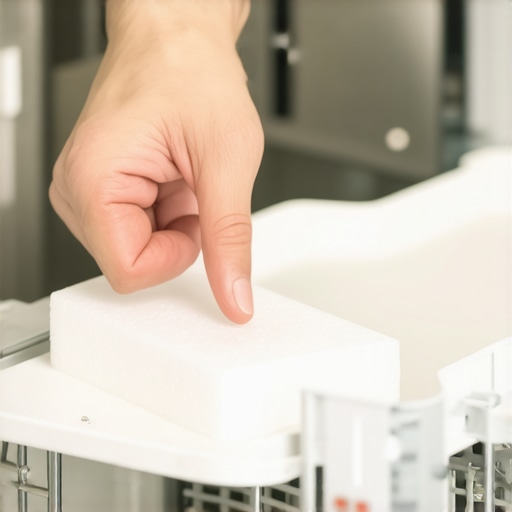
Make Sure Your Float Switch Isn’t Choking on a Pea
Inside that base pan or inside the main tub, there is a float switch. Think of it like the ball in your toilet tank. If it gets stuck in the ‘up’ position because of a stray piece of food, a toothpick, or even a build-up of grease, the machine thinks it is overflowing. You might need to focus on how to clear a blocked impeller with a shop vacuum if the water isn’t moving, but if the tub is empty and the pump is still screaming, wiggle that float switch. It should click freely. If it’s gummy, a little warm water and a soft brush can save you a fortune.
The High Loop Hack That Prevents Backflow
Sometimes the problem isn’t a leak from the machine, but water siphoning back in from your sink. This is where how to identify a cracked water inlet housing before it floods becomes critical, but also check your drain hose. If that hose isn’t arched high above the level of the sink drain, dirty water can flow backward into the dishwasher. The sensors pick up this ‘ghost water’ and start the pump again. Before you worry about identifying a failing sump gasket before the floor warps, ensure your drain hose is Zip-tied to the top of the cabinet. This simple gravity trick keeps the sensors dry and the pump quiet.
Stop Trusting Error Codes as the Gospel Truth
We have been conditioned to believe that if a machine tells us what is wrong, it’s being honest. In the world of appliance repair, this is a dangerous assumption. Most DIYers see a code and immediately order the corresponding part, but in my experience, why your dishwasher screen shows a numeric error code is rarely a direct instruction to buy a part; it is a symptom of an environmental issue. For example, a ‘drain error’ might actually be caused by using too much detergent, which creates suds the pump can’t move. If you replace the pump without addressing the soap, you’ve just thrown $150 into the trash. Real expertise involves troubleshooting dishwasher problems by looking at the chemistry of the water, not just the blinking lights on the panel. Have you ever replaced a part only to have the same error pop up ten minutes later? Let me know in the comments because you aren’t alone.
Why does your machine stay on ‘one minute’ for ten minutes?
This is the ultimate ‘advanced’ frustration. You’re waiting to head to bed, the timer says one minute left, and then it just… stays there. Most people think the control board has a ‘dead spot’ or the timer is failing. The reality is far more nuanced. Modern machines use turbidity sensors to measure how much light can pass through the wash water. According to Energy Star, these soil sensors are designed to adjust cycle time and water use in real-time. If the sensor detects that the water is still ‘cloudy’ with food particles, it will force the machine to continue rinsing, effectively pausing the timer. Paradoxically, why pre-rinsing dishes actually makes your machine less efficient is because if the water is too clean, the sensor might end the cycle early before the detergent has fully activated, leaving a film. It’s why you might see why your new machine stays on one minute for ten minutes while it desperately tries to finish a job it wasn’t properly calibrated for. 
The Garbage Disposal Trap That Kills Your Warranty
Here is the ‘oops’ factor that separates the pros from the amateurs: the knockout plug. If you just installed a new garbage disposal and now your dishwasher pump is screaming and won’t drain, I can almost guarantee you forgot to remove the plastic plug inside the disposal’s drain nipple. This is a classic reason why your warranty claim got denied because of your garbage disposal installation. A manufacturer won’t pay for a service call caused by an external plumbing blockage. Before you panic about the cost of a tech, understand how appliance diagnostics can save your warranty benefits. By proving the machine itself is functioning correctly through a diagnostic mode, you avoid the ‘no-fault-found’ fees that service companies charge. Always verify the real difference between service plans and manufacturer warranties before you start unscrewing panels, as some third-party plans are much stricter about DIY ‘interference’ than the original brand warranty. Knowing these small technicalities is the difference between a free fix and a $300 mistake.If you want to move beyond basic troubleshooting and actually ensure your kitchen stays quiet for the next decade, you need to think like a technician. I don’t mean you need a five-hundred-dollar toolkit; I’m talking about a simple twenty-dollar multimeter and a wet/dry shop vacuum. I personally use my shop vac for more than just cleaning the garage; it is my secret weapon for how to clear a blocked impeller with a shop vacuum. By creating a tight seal over the drain port, you can often suck out the glass shards or fruit pits that a pump just can’t move on its own. Then there is the multimeter. If your machine won’t heat or the motor is dead-silent, testing your thermal fuse for continuity without a pro can confirm a ten-dollar part failure before you spend eight hundred dollars on a new unit. I’ve saved several machines in my neighborhood just by showing friends how to use the ‘ohms’ setting on a basic tester to rule out motor failure.
How do I maintain my dishwasher’s performance over time?
The answer isn’t in a bottle of expensive ‘all-in-one’ cleaner; it’s in the chemistry of your water and the mechanical health of your spray arms. I’ve found that how to clean your dishwasher interior with a single cup of vinegar is a great monthly baseline, but the real pro secret is addressing the hidden friction. You need to know how to deep clean the hidden spray arm bearings where calcium and lime like to build up. If those arms don’t spin at the exact RPM the factory intended, your soil sensor will get confused and keep the machine running for hours. Documentation is your best friend here; for instance, the Whirlpool Technical Service Pointer W10660144 explicitly warns that ‘excessive suds’ from the wrong detergent can trigger false drain errors that look like pump failures. 
Software is the New Spare Part
We are entering an era where the hardware is often fine, but the ‘brain’ is just confused. I’ve seen dozens of cases where why your smart dishwasher needs a firmware update to save water was the actual fix for a recurring error code. Manufacturers are now pushing ‘over-the-air’ updates to fix sensor calibration issues that previously required a technician visit. My prediction? Within the next five years, understanding appliance diagnostics improving your warranty claims will involve your phone talking directly to the factory’s AI to predict pump failure weeks before it happens. If you are currently fighting with a machine that feels like a lemon, keep your service logs and learn how to claim a repair refund from your appliance manufacturer. Don’t just accept a malfunctioning unit; use the data from the hidden diagnostic modes to demand a better product. **Try this today:** Go into your kitchen and run a heavy cycle with a specialized descaler or citric acid—it is the fastest way to descale your heater and keep your energy bills low.
What My Flooded Kitchen Taught Me About Over-Engineering
It took me three flooded kitchens and a very angry cat to realize that the persistent slurping sound isn’t always the end of the world. First, I learned that sensors are often more paranoid than a cat in a room full of rocking chairs. If your detergent creates too many suds, the machine enters a panic mode that mimics a catastrophic leak. Second, I realized that the secret diagnostic mode hidden on your touch control panel is basically a magic wand for resetting these logic loops without needing a degree in computer science. Finally, don’t ignore the physical basics; sometimes a small toothpick in the impeller is the only thing standing between you and a peaceful evening. It’s about listening to the rhythm of the machine rather than just reacting to the noise.
Tools That Actually Save Your Hardwood Floors
If you are serious about skipping the service fee, you need a few staples in your maintenance cabinet. I always keep a bottle of citric acid or a reliable guide on how to clean your dishwasher interior with a single cup of vinegar to prevent the scale buildup that frequently tricks the sensors. For the technical side, a basic multimeter is non-negotiable for testing a thermal fuse for continuity without a pro kit. I also highly recommend bookmarking a reliable list of the top signs your dishwasher needs professional diagnostics so you know exactly when your DIY skills have met their match and it’s time to call in a specialist.
Stop Fearing the Hum and Start Listening
You do not need to be a mechanical engineer to maintain a high-performing kitchen. Most of the time, your dishwasher is just looking for a little attention and a clean filter to keep those internal pumps happy. By taking these small, proactive steps, you ensure that why your warranty claim was denied due to lack of maintenance never becomes a story you have to tell the manufacturer. Grab your towel, check that float switch, and reclaim your peace and quiet today. Have you ever discovered a surprisingly simple fix for a ‘dead’ appliance that made you feel like a genius? Let me know in the comments below!