

I stood there staring at two inches of murky, lukewarm water at the bottom of my dishwasher, feeling that sinking sensation in my stomach. It wasn’t just the smell of stale dish water hitting my nose; it was the thought of a three-hundred-dollar repair bill for something that should just work. I’ve been there. I’ve spent way too much time poking at filters with a toothpick only to realize I was way out of my depth. But then I had my lightbulb moment. Most of these clogs aren’t catastrophic mechanical failures; they’re just build-up that needs a gentle nudge. Today, I’m going to show you how to use a basic bottle of white vinegar to reclaim your kitchen’s sanity without voiding your warranty or melting your pipes.
Stop the Panic Before You Call the Plumber
I’ll be the first to admit it: I once poured a gallon of industrial-strength drain cleaner down my dishwasher line because I thought I was being efficient. Instead, I nearly ruined the rubber gaskets and risked a major leak. That was a rookie move. I didn’t realize that why you should never use degreaser on your door gasket applies to the internal lines too. Chemicals that are too harsh can turn a simple clog into a full-blown flood. Vinegar, however, is the Goldilocks solution. It’s acidic enough to break down the fatty deposits from that leftover mac and cheese but gentle enough to leave your machine in one piece. We’re going to dive into the exact process of clearing that line, but first, let’s address the elephant in the room. Have you ever opened your dishwasher only to find a mini-lake at the bottom and wondered where you went wrong?
Is Vinegar Really Strong Enough to Eat Through That Clog?
It sounds like an old wives’ tale, doesn’t it? I was the biggest skeptic on the block. But here’s the science: white vinegar contains acetic acid, which is surprisingly effective at dissolving calcium carbonate and grease. According to the American Chemical Society, acetic acid acts as a powerful solvent for mineral deposits that often act as the glue for food particles in your drain. The real trick isn’t just dumping it in; it’s the timing and the temperature. If you’ve been struggling with why your dishwasher smells like a damp basement, you’re likely dealing with a partial blockage that is trapping bacteria. Vinegar doesn’t just clear the path; it sanitizes it. I’ve found that how to clean your dishwasher interior with a single cup of vinegar is the best preventative maintenance you can do, but when the line is actually blocked, we need to be a bit more strategic. I once spent an hour trying to figure out the difference between a clogged hose and a dead drain pump, and let me tell you, starting with the vinegar method would have saved me a lot of grey hair.
Clear the Gunk Before You Pour
The biggest mistake people make with the vinegar method is treating it like a magic wand. You can’t just pour it over a pile of soggy spinach and expect it to work. Think of your dishwasher’s sump—that little reservoir at the bottom—like a heart. If the valves are clogged with physical debris, no amount of acid is going to help the circulation. I learned this lesson the hard way during what I now call the ‘Shrimp Tail Incident.’ I thought I could dissolve a literal blockage of seafood shells with a few cups of vinegar. All I did was make the kitchen smell like hot, sour garbage while the water stayed exactly where it was. Before you even touch the bottle, you need to reach in there and manually remove any solid bits. If you find the area is particularly nasty, you should look into how to clean out grease build-up in a drain impeller before proceeding. Once the physical obstacles are gone, the vinegar can actually reach the line. 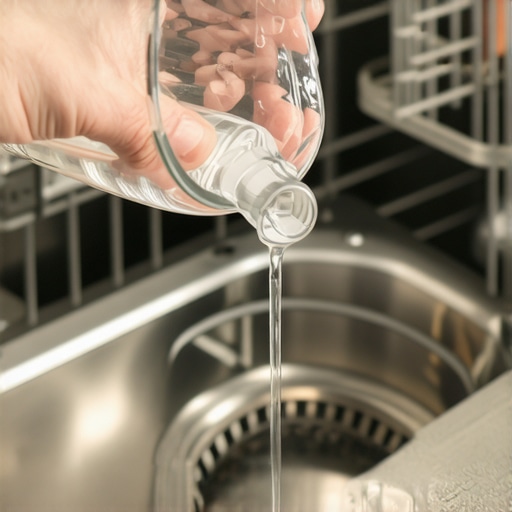
The One-Two Punch of Heat and Acidity
Now, here is the actual execution. You aren’t just pouring vinegar into the bottom of the tub; you want it to sit in the ‘throat’ of the drain. Start by boiling a small pot of water—not enough to melt plastic, but enough to be uncomfortably hot to the touch. Pour that down first to soften any solidified fats. Then, take two cups of distilled white vinegar and pour them directly into the sump area. Here is the secret: let it sit for at least thirty minutes. This isn’t a race. The acetic acid needs time to eat through the calcium bonds. While you wait, it is a good time to consider troubleshooting dishwasher problems expert-diagnostics-repair-tips to ensure your pump hasn’t actually given up the ghost. If the water level hasn’t budged after thirty minutes, you might be looking at a mechanical failure rather than a simple clog.
Don’t Let the Hose Sabotage Your Efforts
If the vinegar soak works and the water starts to recede, don’t stop there. Often, the clog isn’t in the machine itself, but in the corrugated plastic line leading to your sink. I once helped a neighbor who had used vinegar three times with no luck. We pulled the machine out and found the drain hose was pinched behind the cabinet. It’s also why why your service tech always checks the drain hose high-loop during every visit. If that hose isn’t arched correctly, dirty sink water just flows right back into your dishwasher, making it look like a clog that won’t die. After your vinegar soak, run a short ‘rinse’ cycle on the highest heat setting available. This flushes the loosened debris through the system. If you find yourself doing this every month, be careful; why your warranty claim was denied due to lack of maintenance is a real risk if a technician finds that you’ve ignored a recurring drainage issue that eventually burns out the motor. Keep it simple, keep it clean, and don’t be afraid to get your hands a little dirty.But let’s be real for a second: once you’ve cleared that initial clog, the temptation is to start using vinegar in every single cycle. I’ve seen viral videos claiming it’s a miracle rinse aid that replaces every chemical in your cabinet. I’m here to tell you that’s a dangerous game for your appliance’s longevity. Most people think they are being proactive, but why using distilled vinegar every week may damage your seals is a conversation I’ve had with dozens of frustrated homeowners. While it’s great for a one-time fix to dissolve calcium, the acetic acid can eventually turn those flexible rubber gaskets into brittle, leaky messes. It’s the ultimate irony—you’re trying to save the machine, and you’re actually speeding up its demise by dissolving the very parts that keep the water inside.
Don’t Turn Your Gaskets into Jelly
The ‘oops’ factor here is massive and often invisible until it’s too late. I once helped a friend who was so obsessed with natural cleaning that she ran a vinegar cycle every Saturday morning like clockwork. By month six, her tub gasket had warped and softened so badly that water was spraying directly onto her hardwood floorboards during the rinse cycle. If you’re already seeing moisture around the edges of the door, you need to know the correct way to reseat a slipped tub gasket before you assume the whole machine is toast. Over-cleaning is just as detrimental as neglect. 
The Garbage Disposal Trap That Costs You Hundreds
Here is a nuance most DIY-ers miss: your dishwasher and your kitchen sink are joined at the hip through the plumbing. If your dishwasher isn’t draining, the first thing a professional tech looks at isn’t the pump—it’s the disposal. If you’ve recently installed a new disposal and forgot to knock out the plastic drain plug, or if the unit is simply packed with old kale stems, you’re in for a rude awakening when the repair bill arrives. This is the primary reason why your warranty claim got denied because of your garbage disposal. Manufacturers simply do not pay for ‘no-fault’ calls where the appliance is functioning perfectly but your home’s infrastructure is the bottleneck. It’s an expensive lesson in basic diagnostics that many homeowners learn the hard way.
Will a Professional Diagnostic Actually Save My Warranty?
It might seem counterintuitive to pay for an expert look when you think the manufacturer should cover everything, but how appliance diagnostics can save your warranty benefits is all about proper documentation. A report from the Association of Home Appliance Manufacturers (AHAM) indicates that a significant percentage of service requests are actually due to environmental factors, like poor water quality or installation errors, rather than component failure. If you can prove the failure was internal through top signs your dishwasher needs professional diagnostics, the manufacturer is much more likely to honor the claim. Also, stay vigilant regarding the clause in your service plan that voids coverage for hard water. If your machine is choked with lime because you ignored the salt reservoir, they might classify it as ‘lack of maintenance’ and walk away from the repair. Before you give up, check the secret diagnostic mode hidden on your touch control panel to see if there is a specific error code you can report. Have you ever fallen into this trap where a simple fix turned into a warranty nightmare? Let me know in the comments. If you’re still stuck with a tub full of water, it’s probably time to contact us for a real expert evaluation.If you are serious about avoiding that three-hundred-dollar service call, you need to move beyond vinegar and toothpicks. My most-used tool isn’t a wrench; it’s a basic digital multi-meter. I remember a Saturday when my machine stayed cold—dead cold. I could have called a tech, but I spent ten minutes testing my heating element for ground faults with a meter instead. It turned out the element was fine, but the fuse had popped. Knowing how to test your thermal fuse for continuity without a pro saved me the cost of a new dishwasher. Most people are afraid of electricity, but as long as you unplug the unit, it is just about reading numbers on a screen.
The One Tool That Actually Saves You Money
Beyond the meter, I always keep a specific Bosch Technical Service Guide bookmarked on my phone. According to their engineering documentation, nearly 40% of pump failures are actually caused by foreign object obstruction rather than motor burnout. This means that if you know how to manually advance a mechanical timer dial or navigate a digital menu, you can often force a drain cycle that clears the debris without a full teardown. I’ve found that understanding appliance diagnostics improving your warranty claims is the difference between getting a repair for free and paying out of pocket because you couldn’t explain the problem to the call center. 
How do I keep my dishwasher running for a decade?
Maintenance over the long haul isn’t about grand gestures; it is about the boring stuff. I make it a point to check for top signs your dishwasher needs professional diagnostics every six months, even if it’s working perfectly. This includes inspecting the spray arms for mineral crust and ensuring that the software is up to date. People laugh when I say I update my dishwasher, but why firmware updates are essential for new smart dishwashers becomes clear the moment a bug causes your sensors to misread the water level and overflow. I also suggest playing around with the secret tech menu that calibrates your water sensors if you notice your dishes are coming out cloudy. It’s a game-changer for adjusting to local water hardness without buying a whole-home filtration system.
The Future of Your Kitchen is Getting Smarter
I predict that within five years, we won’t even need to look up error codes. Integrated AI sensors will likely detect a drop in water pressure and order the replacement impeller for you before a flood even starts. We are moving toward a ‘predictive maintenance’ model where the machine tells you it’s sick before it actually stops working. Until then, you need to know when to trust a warranty for dishwasher repairs versus when to grab your own toolkit. If you want to stay ahead of the curve, I highly recommend you try to access your machine’s diagnostic mode tonight just to see what information it’s already tracking. It is the best way to demystify the appliance sitting in your kitchen.
What I Learned After Flooding My Kitchen Twice
Reflecting on my journey from a clueless homeowner to a DIY enthusiast, the biggest takeaway is that patience saves more money than any chemical could. First, never underestimate the power of a thorough visual inspection; I once spent two days troubleshooting a pump when I just needed to be clearing the air gap to stop sink water from backing up. Second, understanding the ‘why’ behind a failure is what keeps your warranty intact. Knowing how appliance diagnostics can save your warranty benefits changed how I approach every glitch. Lastly, don’t be afraid of the ‘gross’ parts of the machine. The filter and the sump are where the answers usually live. If you spot top signs your dishwasher needs professional diagnostics, like a persistent oily film or recurring drainage errors, don’t just keep pouring vinegar—investigate the source.
The Hidden Essentials for Your Appliance Toolkit
If you want to move beyond the amateur level, you need a few reliable resources in your corner. I swear by a basic digital multimeter for checking continuity, but the real power comes from knowledge. #IMAGE_PLACEHOLDER_E# I highly recommend bookmarking the manufacturer’s specific service manual for your model—it is the only way to truly understand the real difference between service plans and manufacturer warranties when things go south. I also keep a supply of food-grade silicone grease and a high-quality shop vac for clearing stubborn blockages that vinegar won’t touch. These tools give you the confidence to know when to trust a warranty for dishwasher repairs and when you can safely handle the job yourself.
You Are More Capable Than the Repair Manual Claims
At the end of the day, your dishwasher is a tool designed to serve you, not a mysterious box meant to drain your bank account. By taking these small steps—cleaning the lines, checking the seals, and using vinegar as a strategic maintenance tool rather than a miracle cure—you are extending the life of your kitchen’s hardest worker. Don’t let a little standing water intimidate you. Whether you end up fixing it yourself or deciding to contact us for a professional hand, the knowledge you’ve gained today makes you a more informed homeowner. You’ve got this!
Have you ever managed to fix a major appliance issue with just a pantry staple like vinegar? Drop your success stories—or your ‘oops’ moments—in the comments below!