

It was 10:00 PM on a Tuesday, and my dishwasher was packed with lasagna-crusted plates from a family dinner. I reached under the sink, and my heart sank. Empty. No pods, no gel, not even a stray powder crumb. Then, I saw the jug of laundry detergent sitting on the laundry room shelf, looking all innocent and blue. I thought, ‘Hey, it’s all soap, right?’ Wrong. Within twenty minutes, my kitchen floor looked like a low-budget Ibiza foam party, and I was frantically searching for my manual while water seeped into my floorboards. It was a classic case of an emergency decision gone horribly sideways. Today, I’m going to dive into why this specific ‘hack’ is actually a high-stakes gamble with your appliance’s life and how to manage the fallout without losing your mind.
Stop Before You Pour That Laundry Soap
Making a mistake like this is easier than you think, especially when you are tired and just want the chores finished. I learned the hard way that laundry detergent is formulated for the high-volume, fabric-cushioned environment of a washing machine, not the high-pressure, recirculating spray arms of a dishwasher. When those surfactants hit the sprayers, they create a ‘suds lock’ that can overwhelm the drainage system and force water out of the door seals. If you’ve already seen bubbles creeping across your tile, you need to understand the danger of using standard dish soap in your dishwasher as well, because the chemistry is surprisingly similar in its destructive potential. According to the American Cleaning Institute, the high-sudsing agents in laundry products are specifically designed to suspend dirt in large amounts of water, a process that becomes unmanageable and violent in the confined space of a kitchen appliance.
Will it really ruin my expensive machine?
The short answer is a resounding yes, though perhaps not in the way you expect. While the bubbles are a mess to clean up, the real danger lies in what you can’t see. Excessive suds can cause the pump to cavitate, meaning it tries to move air instead of water, which can lead to motor burnout. Furthermore, many laundry detergents contain optical brighteners and perfumes that can leave a film on your heating element, causing it to overheat or fail prematurely. I once thought I could just rinse it out and be fine, but I later discovered that how appliance diagnostics can save your warranty benefits is a topic you should know before the technician sees the blue residue in your pump. Have you ever been tempted to use a non-kitchen cleaner just to get through a pile of dishes? I’d love to hear your ’emergency’ stories in the comments below. Let’s look at why your manufacturer might not be so forgiving if this happens.
Kill the Power and Stop the Suds Before They Spread
The second you see white foam escaping the door vents, hit the cancel button or pull the plug. Running the cycle only pushes those air bubbles deeper into the pump assembly. Think of suds in a dishwasher like air in a brake line; they compress and expand, preventing the actual liquid from doing its job. This causes the pump to spin wildly at high RPMs without the resistance of water, which is a fast track to mechanical failure. I once tried to ‘wash away’ the suds by adding more water, thinking I could dilute the mistake. It was like trying to put out a grease fire with a leaf blower. The foam just rose higher. Instead, you need to manually remove the standing water. If your machine is stuck mid-cycle, you should learn how to clear a blocked impeller with a shop vacuum because that suction is the only thing that will pull the dense, heavy foam out of the sump area without straining the delicate motor. 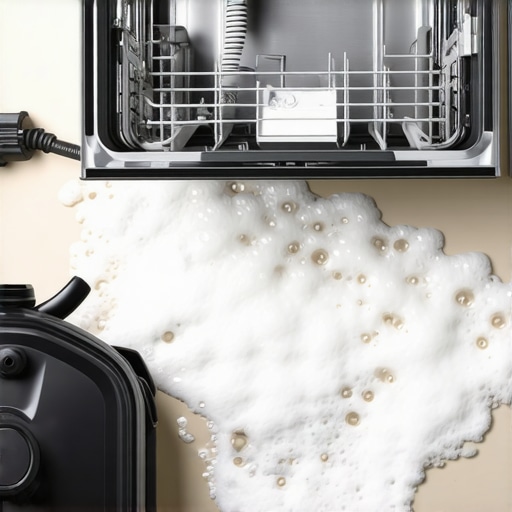
Use Kitchen Basics to Kill the Foam
Once the power is off, grab a bottle of vegetable oil or a handful of salt. It sounds like a kitchen myth, but these act as ‘de-foamers’ by breaking the surface tension of the bubbles. Sprinkle salt liberally over the foam or pour a tablespoon of oil into the bottom of the tub. This collapses the suds-lock instantly. I remember doing this at midnight, feeling like a mad scientist as the wall of bubbles finally began to retreat. Once the bubbles are dead, you can start troubleshooting dishwasher problems-expert diagnostics-repair tips to see if any sensors were tripped during the overflow.
Listen for Mechanical Distress
You also need to listen closely as you attempt to restart the machine after the cleanup. A healthy machine has a rhythmic ‘whoosh,’ but a pump struggling with detergent residue will have a distinct, high-pitched whine. Learning the trick to identifying a failing drain pump by sound can help you decide if you’ve done permanent damage or if you just need another rinse cycle. If the machine continues to beep three times and shuts down, it might be the leak sensor in the base pan—a safety feature that many owners mistake for a dead control board.
Preserving Your Warranty After a DIY Disaster
Finally, be careful about how you document this event if you have a service plan. Many people don’t realize why your warranty claim was denied due to lack of maintenance or improper chemical use. If a technician arrives and finds blue laundry soap residue coating the internal gaskets, they will likely flag the repair as user error. To avoid this, run several ‘Rinse Only’ cycles with plain water once the suds are gone. This ensures that you are following the best practices for how to prevent suds locks in high efficiency machines and keeps the internal components clean. Wiping down the door seals is also critical; laundry detergent is far more alkaline than dish detergent and can degrade the rubber over time if left to sit.Most homeowners assume that if they can clear an error code by unplugging the machine for a minute, they’ve successfully ‘fixed’ the problem. In my years of tinkering with appliances, I’ve found that a manual reset is usually just a temporary gag on a machine that is trying to scream for help. When you force a restart without addressing the underlying issue, you aren’t just delaying the inevitable; you’re likely making the eventual repair far more expensive by allowing a minor leak or a failing sensor to escalate. For instance, understanding appliance diagnostics improving your warranty claims is less about clearing the display and more about interpreting what the internal sensors are actually feeling. Many high-end units feature the secret tech menu that calibrates your water sensors, which can tell you if your water is too hard or if the turbidity sensor is failing due to microscopic soap scum buildup. If you ignore these technical nuances, you’re essentially flying blind.
Your Reset Button is Probably Lying to You
The most common ‘trap’ I see is what I call the silent overflow. Most modern dishwashers possess a secondary drip pan with a float switch located in the absolute base of the chassis. If that laundry soap disaster caused even a tablespoon of water to escape into that pan, the switch will stay engaged even after you’ve mopped the kitchen floor. You might get the machine to run again once by sheer luck, but it will eventually trigger a hard shutdown. Knowing why your machine beeps three times and shuts down can save you from an expensive service call for what is essentially a wet safety sensor that just needs manual drying with a hair dryer. 
Does the machine keep a secret history of my mistakes?
Yes, it absolutely does, and this is the specific detail that often leads to denied claims. Modern control boards store ‘fault histories’ or ‘event logs’ that don’t disappear when the power is cut. When a certified technician arrives, they plug in a diagnostic tool that reveals exactly how many times the motor overheated or if the flood switch was triggered by oversudsing. According to data from the Association of Home Appliance Manufacturers (AHAM), a significant percentage of warranty denials for high-efficiency units are linked to ‘improper chemical use’ or ‘environmental factors.’ This digital trail is why the truth about third party warranties and hidden deductible costs can be so frustrating; the evidence of the ‘laundry soap incident’ is hard-coded into the machine’s memory. You should also investigate how to prove a power surge killed your main control board if you want to differentiate between a user-induced error and a genuine electrical failure. Ultimately, knowing when to trust a warranty for dishwasher repairs comes down to how well you’ve documented your maintenance. Have you ever fallen into the trap of thinking a quick reset fixed a deeper mechanical issue? Let me know in the comments.To stay ahead of these digital event logs and preserve your peace of mind, you need to transition from a reactive mindset to a proactive one. Personally, I do not go anywhere near a dishwasher without my digital multimeter. It is the single most important tool in my kit because it removes the guesswork from electrical failures. For example, knowing the specific way to test a thermal fuse for continuity can be the difference between a simple fifteen-dollar part and a five-hundred-dollar panic buy of a new machine. I also keep a dedicated shop vacuum in the garage solely for appliance emergencies. When you are dealing with a nasty overflow or a clog that refuses to budge, how to clear a blocked impeller with a shop vacuum is a much faster and cleaner method than bailing out greywater with a coffee mug.
How do I keep my dishwasher running like new for a decade?
The secret to longevity is not some expensive miracle chemical; it is consistency. I follow a strict ‘rule of three’ every month: check the filters, inspect the spray arms, and run a descaling cycle. Many homeowners ignore mineral buildup because it is invisible inside the pump, but the real cost of skipping your monthly descaling cycle is not just a bit of lime—it is the added friction on the motor that eventually leads to a total burnout. According to the Bosch Technical Service Manual for SHX models, even a one-millimeter layer of scale on the heating element can increase energy consumption by nearly ten percent. If you want to see a real difference in your utility bills, you should learn how to lower your appliance operating costs by 15 percent just by adjusting your settings and maintenance schedule.  I also suggest keeping a high-lumen flashlight in your utility drawer. It might sound basic, but the flashlight trick for finding micro-cracks in your spray arm has saved me from dozens of mysterious leak diagnoses. These tiny fissures expand under heat and spray water directly at the door seal, mimicking a major mechanical failure. I predict that in the next few years, manual checking will become secondary. We are already seeing how smart diagnostic apps are changing home appliance repair, and soon, AI will predict a pump failure weeks before it happens by analyzing vibration patterns. For now, stay hands-on. Go grab a multimeter and test your thermal fuse today—even if the machine is working—just to get used to the reading. It is the best way to gain confidence before a real emergency strikes.
What the Repair Manual Never Tells You About Foam
Laundry soap isn’t just about the visible bubbles; it is about the microscopic chemical film it leaves behind. I learned that even after the foam disappears, surfactants can coat your sensors, leading to a situation where the top signs your dishwasher needs professional diagnostics only become obvious once the motor starts to overheat. Another lightbulb moment was realizing that the warranty company is rarely your ally during a ‘DIY accident.’ If you find yourself in a bind, knowing the hidden loophole that gets your denied claim reversed is essential, but it is much better to avoid the denial by being thorough with your manual cleanup. Finally, never underestimate a simple physical check; sometimes the foam just jammed the latch, and the simple move to fix a leaking detergent dispenser door is all you need to get back to business.
The Three Tools I Never Repair Without
If you want to handle these kitchen emergencies like a pro, you need more than just a sponge and a mop. I swear by my digital multimeter for verifying electrical components and a high-capacity wet/dry shop vacuum for those midnight overflows. I also keep a copy of the Association of Home Appliance Manufacturers guidelines bookmarked on my phone because these standards are what the pros use to judge user error versus mechanical failure. If a technician plays hardball with your service plan, I have found that knowing how to appeal a rejected extended warranty claim with specific technical documentation is the only way to win your case. #IMAGE_PLACEHOLDER_E#
Build Your Confidence One Fault Code at a Time
It is easy to feel defeated when your kitchen floor is a sea of foam, but every error code is just a piece of data helping you understand your home better. Don’t let a mistake with a bottle of laundry soap make you afraid of your machine’s complexity. With the right tools and a little patience, you can master appliance diagnostics and keep your kitchen running smoothly for years to come. Have you ever accidentally used the wrong soap in an appliance, or did you catch the mistake just in time? Let me know your close calls in the comments below!