

I stood there staring at my brand-new, expensive European dishwasher, feeling like a total amateur. I had just spent a small fortune on this machine, yet my favorite dinner plates were coming out with a gritty, white film that felt like fine-grit sandpaper. I assumed the machine was a lemon. I even considered calling for professional diagnostics before I realized the culprit was that mysterious, heavy-duty plastic cap at the bottom of the tub that I’d been ignoring for weeks. It turns out, that little reservoir isn’t just a design quirk; it’s the heartbeat of your machine’s longevity and the secret to actually getting what you paid for.
Don’t Make the Same Expensive Mistake I Did
In my early days of upgrading my kitchen, I made a classic blunder: I treated my high-end dishwasher like the basic model I grew up with in the 90s. I figured that as long as I threw in a detergent pod, the machine would do the rest. I completely ignored the “Refill Salt” light for six months, thinking it was some marketing gimmick to get me to buy more supplies. The reality is much harsher. If you live in an area with even moderately hard water, ignoring that reservoir is a fast track to internal scale buildup. I eventually learned that the real reason your glasses come out cloudy often has nothing to do with your detergent and everything to do with the ion-exchange system inside that salt tank. Today, I’m going to show you how to manage this system so you don’t end up with a dead pump or a voided service contract. I remember the frustration of re-washing the same load of dishes three times. I was wasting water and time, and my energy bill was creeping up. I even looked into how appliance diagnostics can save your warranty benefits, thinking I had a major mechanical failure. It turns out, I was just starving my machine of the one thing it needed to fight the minerals in my local tap water.
Is this just a clever way to make me buy more stuff?
It’s a fair question. We’re all tired of “subscription” style maintenance for our homes. However, the science is solid. According to the Water Quality Association, hard water minerals can decrease the efficiency of water-using appliances by as much as 48%. In high-end machines, the salt reservoir feeds a built-in water softener. This isn’t just about aesthetics; it’s about protecting the heating element and the delicate sensors. If you let it go, you might find that your warranty claim was denied due to lack of maintenance, which is a conversation nobody wants to have with a manufacturer.
Why Soft Water Changes Everything for Your Warranty
Most people don’t realize that understanding appliance diagnostics starts with the water chemistry. When I finally cracked open my manual, I saw that my “luxury” experience was dependent on a specific chemical balance. Using the wrong salt—or worse, regular table salt—can actually destroy the resin bed in the softener because table salt contains anti-caking agents that clog the system. I’ve seen neighbors ruin a $2,000 Bosch because they thought “salt is salt.” Have you ever looked at that little cap and wondered if you’re actually supposed to do something with it, or have you just been ignoring the warning lights like I did?
Stop the Scale Before It Starts
For years, I ignored that heavy plastic cap at the bottom of my machine, assuming it was just a remnant of European manufacturing I didn’t need to worry about. I was wrong. The salt reservoir is actually the fuel tank for your machine’s built-in water softener. Think of it like a battery; once the ions are spent, the system stops protecting your heating element. When you see that ‘Refill Salt’ light, it’s not a suggestion. If you let it sit empty, you’re practically inviting calcium to coat your internal components. This is often why your dishwasher leaves a gritty film on your glasses, and it’s the first thing a tech will check when they come out to see why your motor is whining.
Feed the Resin Bed to Keep Your Pump Alive
To get started, you need to locate the salt reservoir, usually tucked away on the left or right side of the tub floor. I remember the first time I unscrewed mine; I panicked because water started spilling out. Don’t do what I did and try to siphon it out—that water is supposed to be there. You simply use the provided funnel to pour in coarse dishwasher salt until the reservoir is full. The salt isn’t actually cleaning your dishes; it’s ‘recharging’ the resin beads that grab onto minerals. If you’ve neglected this for a long time, you might eventually need to learn how to unclog the internal water softener valve because stagnant mineral deposits can harden into a physical blockage. 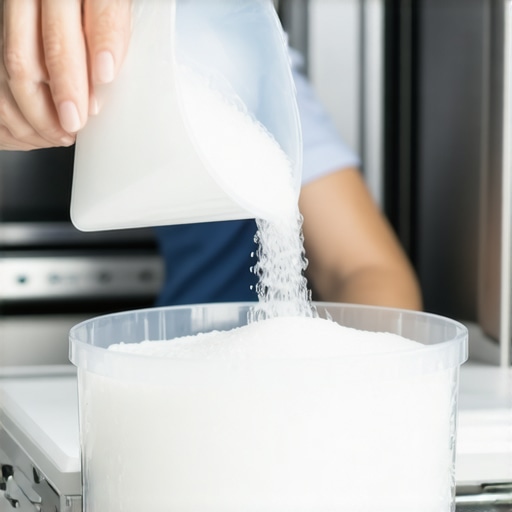
Calibrate Your Machine for Local Water Chemistry
Simply adding salt isn’t enough; your dishwasher needs to know how much to use. Most high-end units have a setting—ranging from H0 to H7—that dictates how much salt is released per cycle. I once lived in a house where the water was so hard it felt like liquid rock. I had the machine set to a factory default ‘low’ setting, and my heating element burned out in eighteen months. When I tried to file a claim, the technician pointed out the clause in your service plan that voids coverage for hard water damage due to improper maintenance. To avoid this, use a test strip to find your grains-per-gallon (GPG) and access the secret tech menu that calibrates your water sensors to match your local reality. This ensures you aren’t wasting salt but are still providing enough to prevent scale from choking your spray arms.
Don’t Ignore the Spill on the Stainless Steel
Here is a mistake I made that cost me a lot of scrubbing time: I spilled about half a cup of salt on the stainless steel floor and just closed the door, thinking the next cycle would wash it away. Salt is incredibly corrosive to metal if it’s left to sit. If you spill any while filling the reservoir, run a ‘Quick Wash’ or ‘Rinse’ cycle immediately. This is just as important as checking for mechanical issues like the paper plate test for spray arm coverage. Keeping the interior clean isn’t just about smells; it’s about preventing the pits and rust that lead to catastrophic tub leaks. If you keep that reservoir topped off and your settings dialed in, you’ll find that your machine runs quieter and your glasses come out looking like they just came off the showroom floor.
I used to be a self-proclaimed ‘clean freak’ who scrubbed every plate until it shone before it even touched the dishwasher rack. I thought I was making the machine’s life easier, but in reality, I was sabotaging its performance. Most people believe that pre-rinsing is a helpful step, but why pre-rinsing dishes actually makes your machine less efficient comes down to modern sensor technology. High-end units use turbidity sensors to measure how much dirt is in the water; if they detect ‘clean’ water early on, they lower the temperature and shorten the cycle. This means the detergent—which is chemically engineered to latch onto food particles—has nothing to do, often leaving a soapy residue or failing to sanitize properly. According to the Association of Home Appliance Manufacturers (AHAM), modern dishwashers are designed to handle significant food soil, and skipping the pre-rinse can save up to 20 gallons of water per load.
Why does my smart dishwasher need a software update anyway?
It sounds like a punchline to a joke about modern life, but why firmware updates are essential for new smart dishwashers is a nuance that catches even tech-savvy owners off guard. I once ignored a notification on my app for three months, only to find that my machine was struggling to finish cycles. These updates often recalibrate the very sensors we’ve been discussing or patch bugs that cause the ‘one minute remaining’ hang-up. If your machine is acting erratic, check the secret tech menu that calibrates your water sensors before you call for a repair. Sometimes, a simple software cache clear is the difference between a smooth cycle and a $200 service call. 
The Garbage Disposal Trap That Kills Warranty Claims
Here is the ‘oops’ factor that I see homeowners fall into time and time again. If you’ve just installed a new disposal or dishwasher, and the machine isn’t draining, do not immediately assume the pump is dead. I’ve seen countless people pay for a service visit only to realize they forgot to knock out the plastic plug inside the disposal’s dishwasher inlet. Worse yet, why your warranty claim got denied because of your garbage disposal is a very real threat. Manufacturers view a blocked disposal or a poorly routed drain line as an ‘installation error,’ not a mechanical failure. A technician will immediately check for the red flag your service tech looks for in your drain line, such as a missing high-loop or a buildup of grease. If they find it, you’re on the hook for the full bill. If you find yourself in this mess, knowing how to appeal a rejected extended warranty claim is your only recourse, but it’s an uphill battle. Have you ever fallen into this trap or been surprised by a warranty denial? Let me know in the comments.
Tools That Actually Save Your Saturday
When I first started taking my kitchen maintenance seriously, I realized that a sponge and some vinegar weren’t going to cut it. If you really want to avoid the headache of a broken machine, you need a small ‘diagnostic kit.’ My most used tool isn’t a wrench—it’s actually a shop vacuum. I use it because how to clear a blocked impeller with a shop vacuum is the single fastest way to remove standing water and debris without making a mess on your hardwood floors. I also keep a cheap multimeter handy. Even if you aren’t an electrician, testing a thermal fuse for continuity without a pro kit can save you from buying a new control board when a $10 fuse is the only thing that actually popped during a power surge.
How do I maintain my dishwasher’s peak performance over the long term?
The secret to a ten-year lifespan isn’t luck; it’s consistency. Every three months, I perform a deep dive into the sump area. Most people just clean the mesh filter and stop there, but I’ve found that how to deep clean a dishwasher sump without pulling the machine involves checking the area around the drain pump for small shards of glass or plastic that the filter missed. These tiny fragments act like sandpaper on the pump’s rubber seals over time. According to technical service manuals from Yale Appliance, nearly 15% of all dishwasher service calls could be avoided if owners simply cleared the physical obstructions from the pump housing before they caused a motor stall. #IMAGE_PLACE_HOLDER_D#
The Era of Predictive Maintenance is Coming
I’m convinced that the days of ‘guessing’ why your machine is acting up are numbered. We are moving toward a world where your appliance will tell you exactly what is wrong before it even stops working. I’ve already started seeing this with how smart diagnostic apps are changing home appliance repair, allowing us to beam error codes directly to a technician via our smartphones. In the next five years, I predict we will see machines that can detect mineral buildup in real-time and automatically adjust the salt release, or even order their own replacement filters when the flow rate drops. For now, we still have to be the ‘brain’ of the machine. If yours is acting sluggish, you should learn how to access the secret diagnostic mode hidden on your touch control panel to see what the sensors are actually reporting behind the scenes.
Don’t Let a Small Part Total Your Machine
It breaks my heart when I see neighbors throw away a perfectly good $800 dishwasher because of a ‘mystery leak’ or a door that won’t stay shut. Usually, it’s a simple fix, like how to swap a frayed door cable in under twenty minutes. If you are ever in doubt about whether a fix is worth the effort, it’s vital to know when to trust a warranty for dishwasher repairs versus when to just grab a screwdriver and handle it yourself. Most minor mechanical issues aren’t covered by standard labor warranties after the first year anyway, so being self-sufficient is your best defense against ‘planned obsolescence.’ Go ahead and try to access that secret tech menu tonight—it’s the fastest way to feel like a pro without actually taking anything apart and can give you a clear roadmap of your machine’s health.
The Day I Finally Stopped Fighting My Owner’s Manual
Looking back, my biggest hurdle was pride. I thought I knew how a kitchen worked, but modern high-efficiency machines are closer to laboratory equipment than simple tubs of soapy water. Here are the lightbulb moments that saved my sanity:
- It’s a chemistry game, not just a scrubbing game. Once I realized the salt was there to recharge resin beads, I stopped viewing it as an optional ‘extra’ and started seeing it as the machine’s lifeblood.
- The sensors are smarter than you think. When your machine hangs on that last minute, it’s usually trying to tell you something about water quality or temperature. Don’t just pull the plug; listen to what the expert diagnostics are trying to show you.
- Small parts cause big headaches. A tiny tear in a seal is a flood waiting to happen. I’ve learned that the correct way to reseat a slipped tub gasket is a five-minute job that saves a thousand-dollar floor repair.
My Go-To Kit for Keeping the Tech Happy
You don’t need a van full of tools to keep your kitchen running. I trust a few specific items to keep me out of trouble. First, always keep a simple LED light nearby; the flashlight trick for finding micro-cracks in your spray arm has saved me from replacing pumps that were actually fine. Second, keep a set of water hardness test strips in your junk drawer—they are more accurate than any local water report. Finally, I always suggest keeping a digital copy of your warranty handy so you know when to trust a warranty for dishwasher repairs and when to pick up the screwdriver yourself. I also keep a bookmark for reliable parts suppliers, as the truth about non-manufacturer repair parts and your warranty is something every owner should understand before they buy a cheap knock-off filter online.
Your Machine is Waiting for a Second Chance
Taking care of your dishwasher doesn’t have to be a chore that eats up your entire weekend. By shifting your mindset from reactive ‘fixing’ to proactive ‘caring,’ you’re not just saving money—you’re ensuring your home runs smoothly. Whether it’s adding salt, clearing a filter, or performing your own appliance repair and maintenance checks, you have the power to extend the life of your machine by years. Don’t wait for a flood or a foul smell to start paying attention. Have you ever been surprised by a simple fix that solved a seemingly massive dishwasher problem? Let me know your success stories below.